A Brief History of the Standardbred and Harness Racing
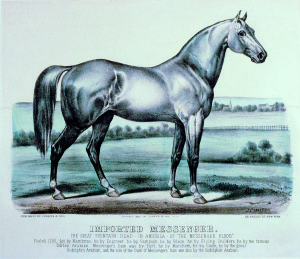
The same year the United States Constitution was ratified in 1788 a Thoroughbred stallion named Messenger was imported into the United States from England. Messenger was the foundation of the American Standardbred lineage as well as the sire of many of the great Thoroughbred lines. The great Thoroughbred Man O’War was a descendant of Messenger.
The racing of trotters started in the 1700’s on rural American roads between common citizens. The term standard was introduced in late 1790’s as a reference on the ability of a horse to trot in a standard time of a mile in two and a half minutes or less. The typical Standardbred of the 18th and 19th century was also usually a family’s work or transportation horse as well as a part time race horse. Standardbred history is interwoven into American history ever since. For example the song Camptown Races is a reference to Standardbred races. The popular Christmas song Jingle Bells is believed to reference a Standardbred sleigh racing in Massachusetts in the mid-1800s.
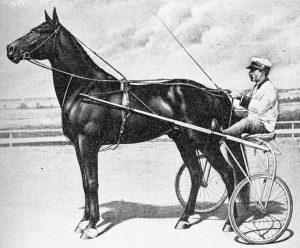
The great pacing phenomenon Dan Patch was the early 1900’s sports marketing version of our modern era Tiger Woods. He had a huge popularity with the American public and his name was marketed on an amazing variety of consumer products.
The development of the modern American Standardbred can be traced to a wide array of contributing breeds; Thoroughbred, Morgan, Narragansett Pacer, Norfolk Trotter, Hackney, and Canadian Pacer. In upstate New York in 1849 a horse named Hambletonian 10, or Rydsyk’s Hambletonian, was foaled. The foal was purchased by William Rydsyk, the foal’s caregiver, for $125. Hambletonian became the sire that nearly all American Standardbreds can be traced back to, and “The Hambletonian” is the title for the greatest harness race in the United States. The funny thing is that Hambletonian never raced.
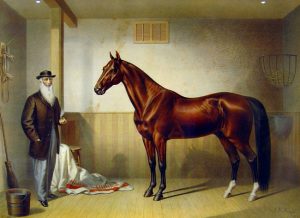
In many respects, the Standardbred resembles its ancestor the Thoroughbred. The variance is that they typically do not stand as tall, averaging 15.2 hands, and has a longer barreled body. The head is refined, set on a medium-sized neck. The quarters are muscular yet sleek. The clean hind legs are set well back. Individual Standardbreds tend to either trot or pace. This breed appears in varying colors, although bay, brown and black are predominant. It weighs between 900 and 1100 pounds.
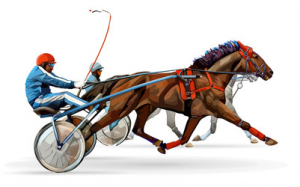
Standardbred racing is contested on two gaits, the trot and the pace. Trotters move with a diagonal gait; the left front and right rear legs move in unison, as do the right front and left rear. It requires much skill by the trainer to get a trotter to move perfectly at high speeds, even though the trotting gait is a natural one in the animal world. But horseman and fans agree that there are few things more beautiful than a trotting horse in full stride.
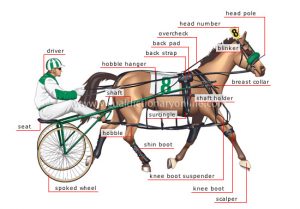
Pacers, on the other hand, move the legs on one side of their body in tandem: left front and rear, and right front and rear. This action shows why pacers are often called “sidewheelers.” Pacers, which account for about 80 percent of the performers in harness racing, are aided in maintaining their gait by plastic loops called hobbles, which keep their legs moving in synchronization. Due to the sureness of their action, pacers are usually several seconds faster than trotters.
Harness racing is now popular across the world. If you look at the family history of the greatest performers from across the world; France, Norway, Sweden, Italy, Australia, New Zealand… you will see that many of these champions trace their roots to American sires.
Join the sport!
Why choose Harness Racing?
When people start thinking about race horse ownership their minds immediately jump to Mint Juleps and owning the Kentucky Derby winner. The financial hurdles to enter, as well as keep afloat, in the thoroughbred game are extremely high and carry a higher risk than harness racing. This is truly the sport of Kings, Queens and Sheikhs… So if you want to win the Derby you may need the strength of the GDP of an OPEC nation to pursue your dream.
Harness racing is different – our entry costs are cheaper for purchase, our maintenance costs are much less than the thoroughbred industry. A common training fee for thoroughbreds is around $100/day depending on location and trainer. You can locate very good harness trainers at half that cost. The purse money in harness racing is divided among the first 5 finishers with the winner getting 50% (2nd–5th: 25%, 12%, 8%, 5%). The driver and trainers customarily earn 5% each of the purse.
If you want entertainment and excitement from your investment the Harness Game offers the better value for the dollar. Depending on your horse and trainer you may even have the opportunity to jog your own horse – this type of hands-on experience is not a part of the thoroughbred race horse world.
Ownership
There are multiple ways to own a horse or a part of one:
Individual Ownership
In the scenario of an individual owner – you pay all the bills and take all the risks, but you also reap all the rewards and the purses your horse wins.
Partnership
In a partnership, you and your partner(s) share paying the bills and assuming risks – and each takes a cut of the purses. Partnerships can also be “unbalanced,” in which each partner owns a different percentage. Your trainer can also be your partner. There are many trainers that accept “deals” on training horses; such as splitting the earned purses in lieu of a training bill.
Limited Partnerships
A growing number of people, especially those with limited amounts to invest, have invested in limited partnerships. In a limited partnership you put up a fixed amount towards the management of a horse’s racing career. A “general” or “managing” partner makes all the decisions. You will share proportionately in the purses won, and in a worst-case scenario will not lose more than what you have invested.
Making the Purchase
Private Sale
A private sale brings one buyer together with one seller. An owner may want to sell for a number of reasons: he wants to buy a different horse, to dissolve a partnership, or just because he feels like it. These sales are immediate, and since horses are “traded” frequently, your trainer probably already knows of a few that might be for sale.
Auctions
At an auction the horses are sold to the highest bidder. Some sales feature only yearlings. Other types of sales include “mixed” sales, which offer active racehorses, broodmares, stallion prospects, and yearlings. Sales offer large numbers of horses, and most at mixed sales are ready to race.
Claiming
A claiming race is one from which a horse can be purchased for a pre-determined price right out of the race. A qualified buyer puts in the claiming price before the race, and the title to the horse changes at the start of the race. The “old” owner gets the purse and the “new” owner gets the horse at race end. Claiming is often the best option for novice horse owners, because it permits them to get in the game immediately.
Breeding Your Own
Beyond purchasing a racehorse, there is another way to enter the Standardbred business – buying a broodmare, mating it to a stallion, and raising your own horse. Any profit from the sale of a yearling, and the enjoyment of winning races and purses are a long way off, making breeding less appealing to a new owner. Most, however, purchase a “ready-made” racehorse and get right to the business of racing and winning!